
Short answer: when LED, when LCD, when a projector
- LED screen, when the area is large, viewers stand from about 3 m away, the room is bright or the screen works outdoors.
- LCD wall, when viewers stand closer than 3 m, sharp text up close matters and the area is small.
- Projector, when the room can be darkened and the picture needs to be large, without a permanent installation.
We sell LED screens, so we say plainly when LED loses. The LED figures come from FOS manufacturer documentation; for LCD and projectors we give principles, because their specifications depend on the model.
Comparison on six criteria
| Criterion | LED screen (FOS ICON) | LCD wall | Projector |
|---|---|---|---|
| Brightness | 800 cd/m² (Icon 2.6, indoor), 4,000 cd/m² (ICON 2.9 Hybrid), 4,500 cd/m² (ICON 3.9 IP) | usually designed for indoor use | depends on the room lighting; in a bright room the picture loses contrast |
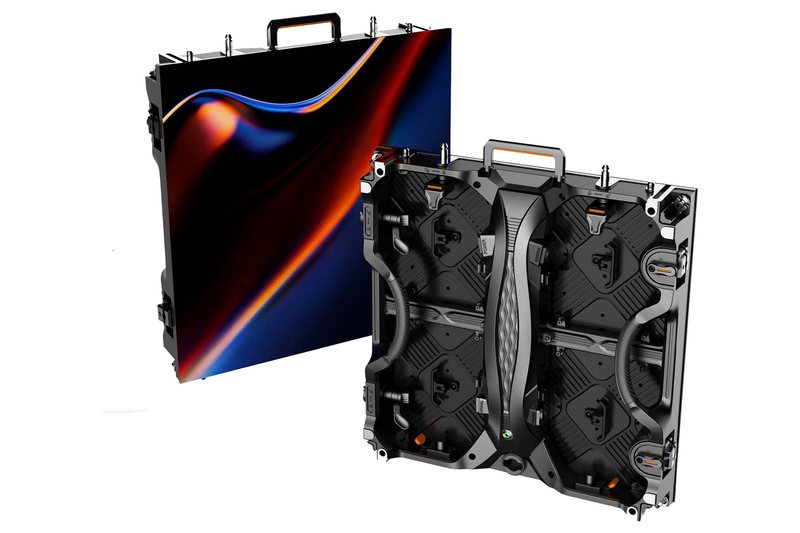
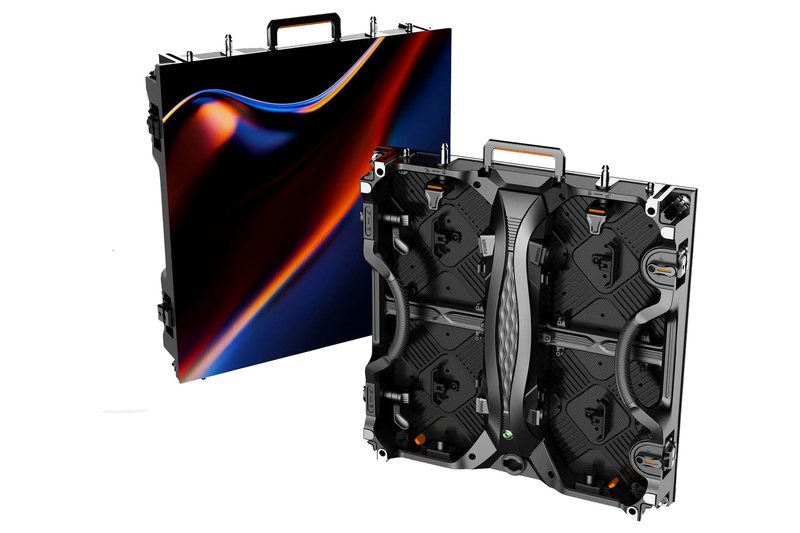
| Size | 50 × 50 cm cabinets, the screen grows in 0.5 m steps; the minimum order is 8 cabinets, i.e. 2 m² | size is a multiple of the monitor diagonal | picture size depends on distance and lens |
| Seams | no bezels; surface flatness ≤ 0.5 mm | visible bezels between panels | no seams with a single projector |
| Viewer close up | pitch from 2.6 mm, viewing distance from 3 m | sharpest picture up close | depends on projector resolution |
| Cost | 4 cabinets per m²; the processor and distribution box do not grow with every metre, so a large screen is cheaper per metre | you pay for every panel and its frame | usually a low entry cost; add a projection screen and blackout |
| Service | a 250 × 250 mm module is replaced from the front; power supply and cards in one power box | panel or monitor replacement | service of one device and its lens |
Where LED wins: brightness, size and no bezels
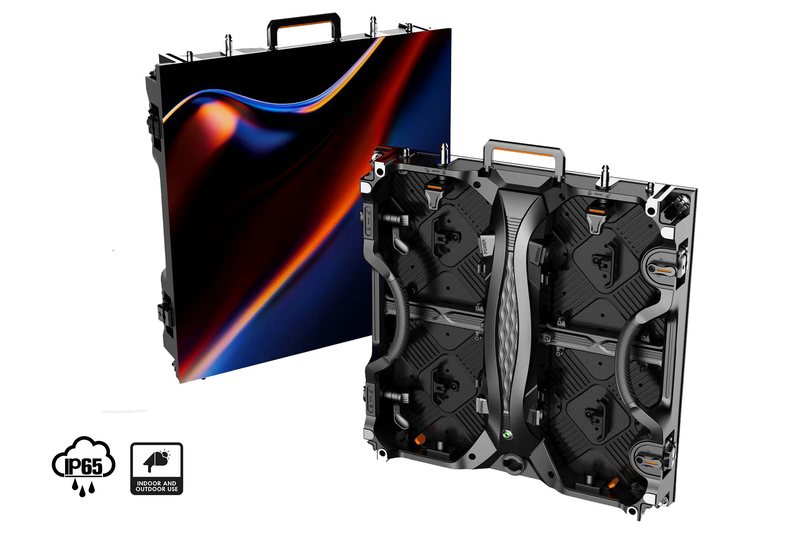
An LED screen emits its own light, so it does not depend on darkening the room. The IP65 models have 4,000 cd/m² (ICON 2.9 Hybrid) and 4,500 cd/m² (ICON 3.9 IP) and work outdoors; Icon 2.6 has 800 cd/m² and is for indoor use only.
You assemble 50 × 50 cm cabinets into a screen in 0.5 m increments, also as a curve (joint angle from −5° to +5°). The cabinets have no bezels like those that divide the picture into squares in an LCD wall, and FOS gives the screen's surface flatness as ≤ 0.5 mm. Cabinets with different resolutions can be combined in one screen, and the frame, beam and flight case are shared across the whole series.
Where LCD or a projector wins
The finest pitch in our range is 2.6 mm, and the manufacturer gives a viewing distance of 3 m for it. When a viewer stands 1–2 m from the screen (at a counter, in reception or at a conference table), an LCD wall will show a sharper picture than any screen in our range. LED resolution also depends on size: Full HD on Icon 2.6 means a 5 × 3 m screen (1920 × 1152 px), and on a smaller area an LCD wall will show more detail.
A projector wins where the room can be darkened and the picture should be large, temporary and without a permanent installation. With an LED screen the minimum order is 2 m² (8 cabinets), and the processor and power are part of every set, even the smallest.
If you choose LED: which model
You choose the model by the distance to the nearest viewer: from 3 to 4 m Icon 2.6 (the finest pitch, from 3 m per the manufacturer), in the 4–5 m band ICON 2.9 Hybrid, beyond 5 m ICON 3.9 IP. Icon 2.6 is for indoor use only and not suitable for sunlit shop windows, so outdoors and in sunlight the IP65 models remain. Tables and examples: how to choose LED pixel pitch. Conference rooms are covered in a separate guide: LED screen for a conference room.
4 × 2.5 m screen, viewer from 4 m. Free, no sign-up, PDF sheet
Price an LED screen for your roomCost, installation and power
An LED screen is a system: cabinets (4 per square metre), processor, power, structure and flight cases. The processor and distribution box do not grow with every metre (one VX600 Pro handles roughly up to 25.5 m² of Icon 2.6 screen), so the larger the screen, the lower the cost per metre; on a small area this advantage disappears. With an LCD wall you pay for every panel and its frame, and with a projector for the device, the screen and blackout. LED complete-set prices and sample quotes: how much does an LED screen cost.
- Weight: an 8 kg cabinet, i.e. 32 kg of panels alone per square metre; the supporting structure is part of the project.
- Power: up to 450 W/m² (Icon 2.6) or 600 W/m² (ICON 2.9 Hybrid, ICON 3.9 IP) of maximum power.
- Installation: you hang the screen on Icon Hanging Beam PRO beams or set it on a ballasted structure, which we select after the site survey.
- Temperature: operation from −20 to +40 °C; above 30 °C air conditioning is needed.
- Signal: a NovaStar processor matched to the pixel count. Which processor for which screen.
LED screen service
In an LED screen you replace a single 250 × 250 mm module from the front, without dismantling the whole screen. The power supply, receiving card and HUB card form one quick-swap “3-in-1 power box” module. We add a service spare to the screen: 5% of the cabinets, minimum 2, topped up to a full case of 8. The manufacturer gives a 2-year warranty and requires an inspection at least once a year; the Priority and Managed VEX support packages include periodic inspections. We handle warranty claims and post-warranty service: +48 794 797 959, biuro@vex-systems.pl. Support packages: service and support.
How to buy an LED screen from us
- 1. Configuration. Enter the viewing distance, dimensions and mounting method; you get a net price and a PDF sheet.
- 2. Site survey. 600 PLN net, credited towards the project.
- 3. Order. Per project, in batches of 8 cabinets; the lead time is confirmed in the offer.
- 4. Installation and commissioning. From 3,800 PLN net, with colour and brightness calibration across the cabinets.
6 × 3.5 m screen, ICON 3.9 IP. Free, no sign-up, PDF sheet
Price an outdoor LED screenDescribe the room and the viewing distance; we reply within 1 business day
Send a B2B enquirySee also: FOS ICON LED screens, LED screen installation and buying a stage LED screen.